
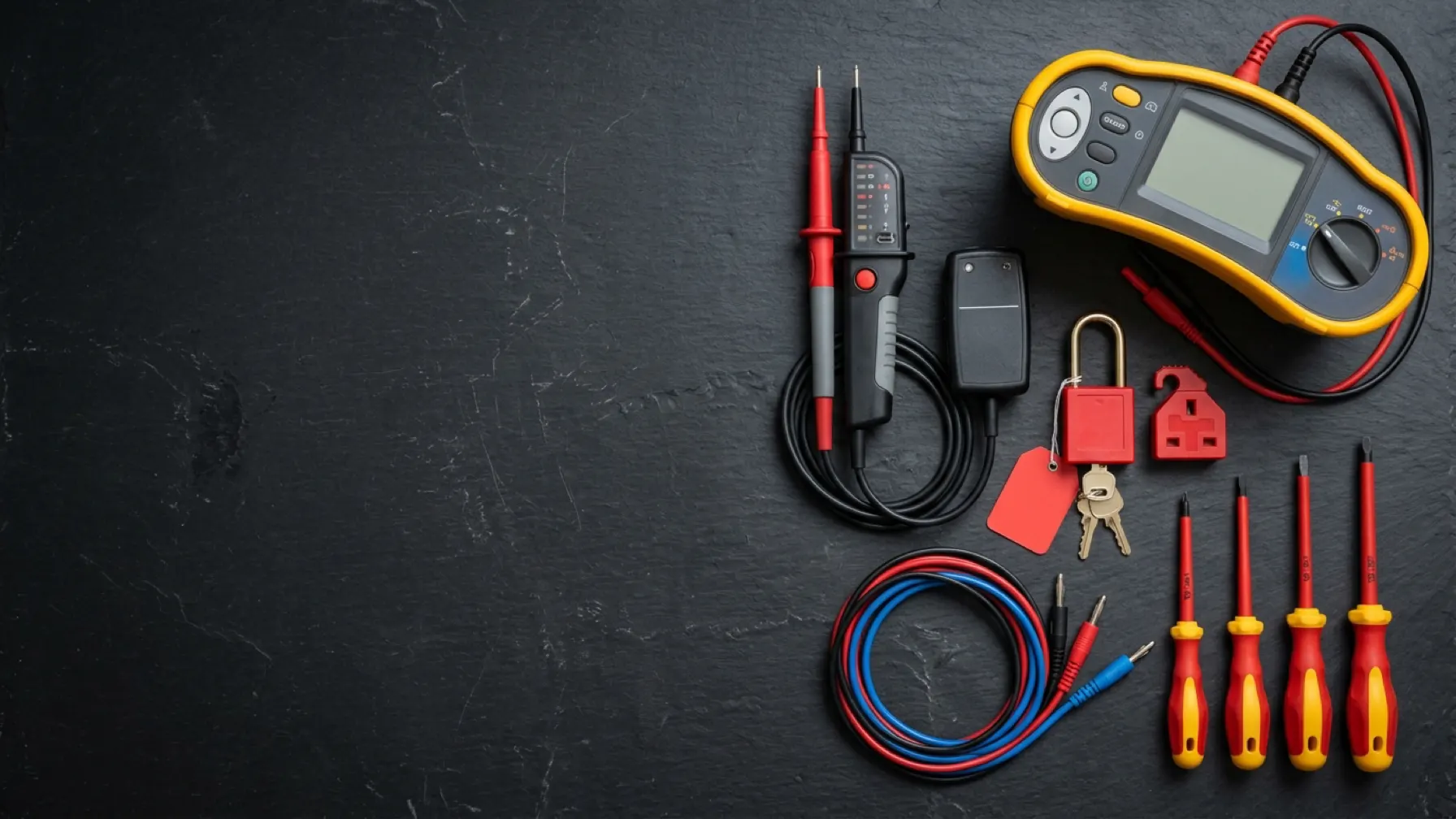
Why this matters more than its exam weighting suggests
Safe isolation carries only a few questions in the mock exam, but getting it wrong on site is what kills people. It is also the one area where the governing document is not BS 7671 but HSE Guidance Note GS38, alongside the Electricity at Work Regulations 1989.
Regulation 14 of EWR 1989 is the one to know: no person shall work on or near a live conductor unless it is unreasonable in all the circumstances for it to be dead, it is reasonable in all the circumstances for the work to be done live, and suitable precautions are taken. The default is dead. Working live has to be justified, not merely convenient.
The prove–test–prove sequence
Three steps, and the order is the whole point:
- Prove the voltage indicator works, on a known live source or a proving unit.
- Test the circuit to confirm it is dead.
- Prove the indicator again on the known live source, to confirm it has not failed during the test.
The final step is the one people skip and the one the exam asks about. Without it, an indicator that failed silently between steps 1 and 2 would have told you a live circuit was dead — and you would have no way of knowing.
When testing, check between all combinations: line to neutral, line to earth, and neutral to earth. On three-phase, that means every phase to every other phase, every phase to neutral, and every conductor to earth.
Securing the isolation
Proving dead is not the end of it. The isolation has to stay isolated:
- lock off the device with a lock-off device and padlock, keeping the only key on your person
- fit a caution notice identifying who isolated it and why
- where the point of isolation is remote from where you are working, this matters more, not less
An isolation someone else can restore while you are working on the circuit is not an isolation.
GS38 — test probes and leads
GS38 sets out what test equipment must look like if it is going to be used safely on live circuits. The requirements the exam asks about:
Probes
- exposed metal tip not exceeding 4 mm — and 2 mm or less is strongly recommended
- finger barriers or shaped guards, so the hand cannot slip down onto live metal
- probes and leads to BS EN 61010-031, with a two-pole voltage detector to BS EN 61243-3
Leads
- adequately insulated, flexible and of sufficient capacity for the duty
- coloured to distinguish one from another
- long enough for the job, but no longer than necessary
- sheathed to protect against mechanical damage, with no accessible bare conductor
Fusing
Test leads and probes should be protected by an hbc fuse, with a current rating usually not exceeding 500 mA — though a higher rating, typically 10 A, applies to a loop impedance or RCD tester. A current-limiting resistor and fuse is an acceptable alternative.
Why a two-pole voltage detector, not a multimeter
A dedicated two-pole voltage indicator to BS EN 61243-3 is the right instrument for proving dead. A multimeter is not, for two reasons that both come up in exam questions:
- a multimeter can be left on the wrong range, and will happily show a low or zero reading on a live circuit set to measure resistance or current
- a high-impedance multimeter can pick up induced or phantom voltages on a dead conductor, or fail to register a genuine live one through a poor connection
A two-pole detector has no range switch to get wrong and loads the circuit enough to discriminate between a real supply and an induced voltage.
Non-contact voltage “pens” are a screening tool only. They never prove a circuit dead.
Measurement categories
CAT ratings describe how much transient energy an instrument can survive at the point you use it. The closer you get to the origin of the supply, the higher the available fault energy and the higher the category needed.
| Category | Where it applies | Examples |
|---|---|---|
| CAT II | Circuits directly connected to the installation | Appliances, portable tools |
| CAT III | The building’s fixed installation | Distribution boards, socket-outlets |
| CAT IV | The source or origin of supply | Meters, the main fuse |
HSE Guidance Note GS38 (4th edition).
The category and the voltage rating go together: a CAT III 600 V instrument is not adequate where CAT IV 600 V is required, even though the voltage matches. Work at the origin — at the meter, at the main fuse — needs CAT IV.
Common exam mistakes
- Giving the sequence as prove–test, leaving off the second prove.
- Using a multimeter to prove dead, or treating a non-contact pen as proof.
- Quoting 4 mm as the recommended probe tip. 4 mm is the maximum; 2 mm or less is recommended.
- Confusing CAT III with CAT IV at the origin of the supply.
- Proving dead but not locking off, or locking off and leaving the key where someone else can reach it.