
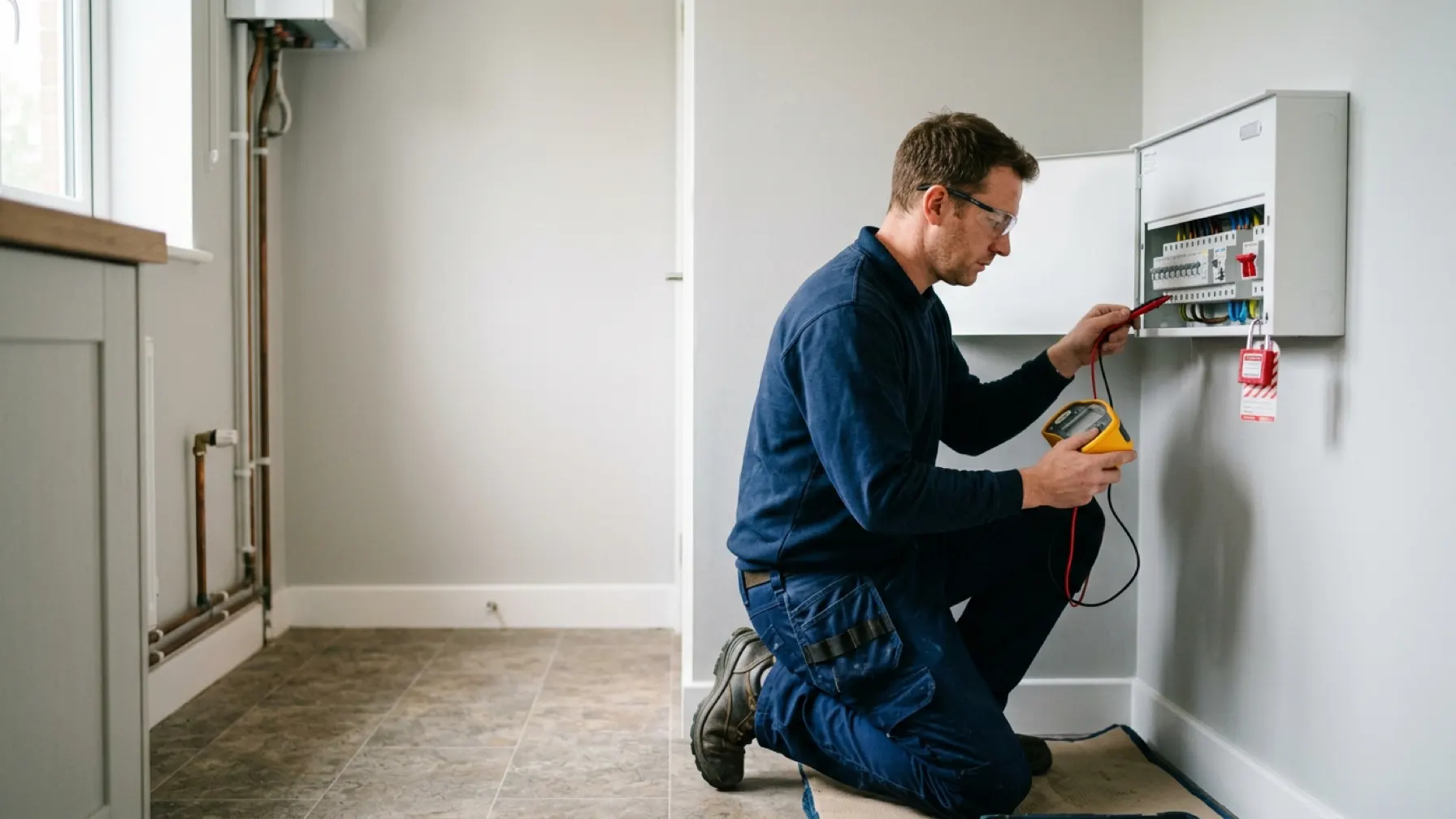
What periodic inspection is for
Periodic inspection assesses whether an existing installation is in a satisfactory condition for continued service. It is a different question from the one initial verification answers. Initial verification asks “does this comply with BS 7671?”; periodic inspection asks “is this safe to keep using?”
That difference drives almost everything else about the process. An installation wired to an earlier edition of BS 7671 is not automatically unsatisfactory just because the current edition would require something different. What matters is whether the departure from current standards creates a danger, or a potential danger, to the people using it.
The result is recorded on an Electrical Installation Condition Report (EICR), under Regulation 653.1.
Extent and limitations
Before any work starts, Regulation 653.2 requires that the extent of the installation covered and any limitations on the inspection are agreed with the person ordering the report and recorded on it.
This is not paperwork for its own sake. It is the boundary of what you are taking responsibility for. Typical limitations include:
- areas that could not be accessed — a loft with no boarding, a locked plant room, a wall behind fitted furniture
- equipment that could not be de-energised because the occupier could not lose supply
- the sampling percentage applied, where a full inspection of every accessory was not practicable
- circuits that were in use and could not be tested
An EICR with no limitations recorded on an occupied installation is treated with suspicion in the exam and in practice, because it is very rarely true.
Sampling
On a large installation it is often not reasonable to inspect and test every point. Sampling is permitted, but the extent of the sample must be recorded, and it must be representative rather than convenient. If the sample turns up defects, that is a reason to widen it — a fault rate found in 10% of accessories says something about the other 90%.
What can and cannot be done in service
An occupied installation constrains what you can do. Some tests are straightforward:
- earth fault loop impedance at accessible points
- RCD operating times
- continuity of protective conductors and bonding
- visual inspection of accessible parts
Others are harder. A full insulation resistance test requires the circuit to be dead and equipment to be disconnected, which on an occupied installation may mean losing the supply to a business or a household for a period. Where an IR test is limited — for example, tested at a reduced voltage, or with equipment left connected — that limitation is itself recorded.
Never let a limitation quietly become an omission. “Not tested” recorded on the report is a professional answer. “Tested” recorded when it was not is not.
Recording observations
Every observation goes on the report with a classification code. The four codes, and what each demands, are covered in full under fault coding:
| Code | Meaning | Action |
|---|---|---|
| C1 | Danger present, risk of injury | Immediate remedial action required |
| C2 | Potentially dangerous | Urgent remedial action required |
| C3 | Improvement recommended | Advisory |
| FI | Further investigation advised | Advisory |
Reaching the overall assessment
This is the single rule the 2391-52 tests most reliably:
The overall assessment is unsatisfactory only where a C1 or a C2 is recorded. C3 and FI are advisory, and do not by themselves make a report unsatisfactory — though they should be given due consideration.
Two consequences follow, and both appear in exam questions:
- A report with a dozen C3s and nothing worse is still satisfactory. Uncomfortable reading, but satisfactory.
- A report with a single C2 is unsatisfactory, no matter how good the rest of the installation is.
An FI does not make the report unsatisfactory either — but it does mean something was found that could not be resolved on the day, and it needs following up without delay. If the further investigation later reveals a C1 or C2, the assessment changes accordingly.
The next inspection date
The report recommends an interval until the next inspection. That recommendation is a judgement based on the installation’s type, use, age, condition and the external influences it is subject to — not a number pulled from a table. A domestic rental property, an industrial unit and a caravan site do not get the same interval, and an installation found in poor condition may warrant a shorter one than its type would normally suggest.
Common exam mistakes
- Marking a report unsatisfactory because of C3 observations. It is not.
- Coding an installation as defective purely because it was wired to an earlier edition. Age alone is not a defect.
- Failing to record limitations, then being asked to justify what was and was not covered.
- Confusing the EICR with the EIC. The EICR reports on condition; the EIC certifies new work.
- Treating FI as a severity between C2 and C3. It is not a severity at all — it means the inspection could not reach a conclusion.